

Dynasty Fine Wines
A Glen Iris wine merchant trading since 1995, with 1,107 bottles browsable by varietal and an AI consultant that answers "something like a Burgundy, under $60" from live stock.
- Client
- Dynasty Fine Wines
- Industry
- Wine retail & bar — Glen Iris, Melbourne
- Services
- Product design, Catalogue & search, AI retrieval assistant, Web development
Outcome
1,107 bottles
Catalogue
Live count on the shop page, merchant-maintained daily
Live stock only
AI consultant
Retrieval over real inventory — never recommends an empty shelf
1.2s
First paint
Throttled mobile connection, median of 9 runs
The problem
What the client was up against
Dynasty Fine Wines had thirty years of standing in Glen Iris and a problem that gets worse the better your range is. The cellar runs past eleven hundred bottles. That depth is the entire reason to shop there rather than at a chain — and online it becomes a liability. Nobody scrolls eleven hundred products. The customer who walks in and says "I want something like a Burgundy but under sixty dollars" gets a two-minute conversation with someone who knows the shelves; the same customer on a website gets a grid, a search box that only matches words in a title, and no idea where to start. So the merchant's actual asset — knowing the range — was the one thing the website could not carry.
The approach
How we decided to build it
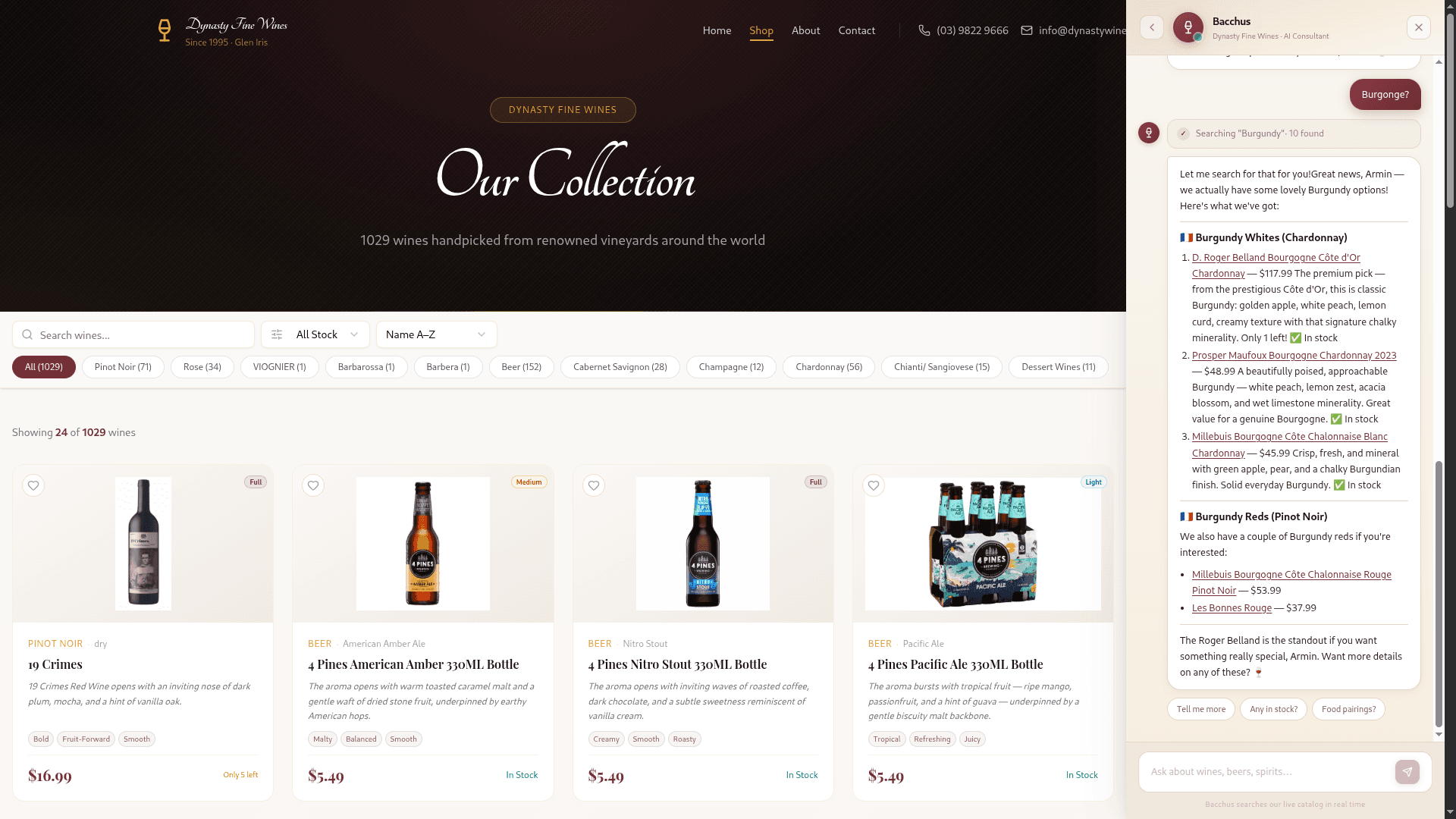
We built the thing that conversation does, instead of a bigger filter panel. "Bacchus" is an AI consultant that queries the live catalogue and answers in the shape a person asks. Ask it about Burgundy and it comes back with specific bottles, prices, tasting notes and current stock — "only 1 left" where that is true — not a filtered grid you still have to interpret. It is retrieval over real inventory, not a chatbot improvising about wine, which is the distinction that decides whether a tool like this builds trust or destroys it. The constraint we set ourselves: it may only recommend what is actually in stock. A recommendation engine that sends someone to an empty shelf costs more goodwill than it earns, so availability is part of the retrieval, not a disclaimer underneath it. Conventional faceted browsing sits alongside it rather than being replaced — varietal facets with live counts, stock filters and sorting — because a customer who already knows they want Chardonnay should not have to hold a conversation about it.
Eleven hundred bottles, structured
Every bottle carries a varietal, a body, tasting notes, flavour tags and a live stock level. That structure is what makes everything else possible. The facets count themselves, the stock filters are real rather than decorative, and the AI has something factual to retrieve against instead of a page of prose. It is unglamorous data modelling and it is the difference between a catalogue that scales to a thousand items and one that collapses at two hundred. The catalogue listed 1,029 bottles when we last captured it and lists 1,107 today — it is maintained by the merchant, daily, without a developer involved.
Local-first, deliberately
The site opens "by locals, for locals" and states the Malvern Road address, the phone number and seven-day trading in the first screen. That is a positioning decision as much as a design one. A Glen Iris merchant is not trying to out-range Dan Murphy's, and pretending otherwise online is how a specialist ends up competing on price against someone who will always win. Leading with the shopfront frames the business as the thing it actually is — and the AI consultant then does what the chain cannot: give you an opinion.
Fast enough to browse a cellar
The page starts showing the cellar in about a second on a phone on mobile data, which is where most evening browsing actually happens. That number is the one worth optimising for a business like this. Nobody browses wine with intent on a stalled page — they close the tab. Getting the first screen up quickly, and keeping the layout still while the rest arrives, is what turns idle curiosity into a basket.
Built with
Next project
Soheil Luxury Auto Wraps
Upload one photo of your car, pick from 80+ Avery SW900 colours, and see the wrap on your own vehicle in about ten seconds — then book the install.